
Leakage in pipelines can cost industries millions in losses and unplanned downtime. Industrial systems in sectors like oil and gas, chemical processing, and water management frequently face leaks at flange joints — resulting in pressure drops, efficiency losses, environmental risks, and higher maintenance costs.
This is where drip rings become highly relevant, offering an additional layer of sealing support that enhances system integrity and minimizes leakage risks.
What Are Drip Rings in Industrial Pipeline Systems?
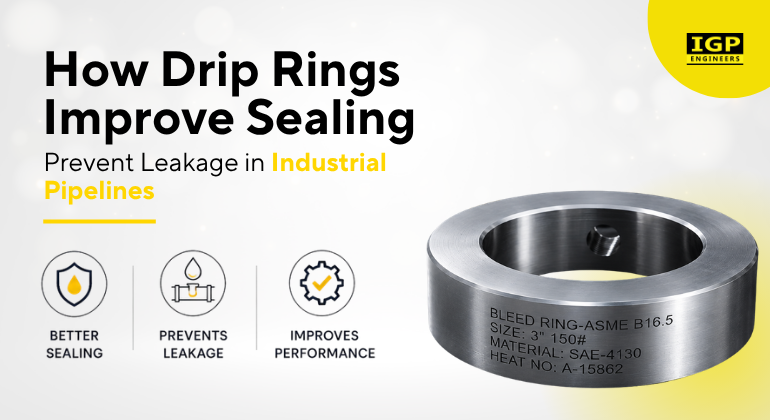
Drip rings — are specialized components installed between flange connections to improve leakage control and sealing efficiency. Unlike primary sealing elements such as gaskets, they function as a secondary protective mechanism that helps manage, monitor, and direct any fluid that bypasses the primary seal.
Also known as bleed rings or vent rings in the piping industry, drip rings are circular fittings installed between flanged connections to enable controlled venting, draining, and pressure monitoring — without disrupting pipeline operations.
Applicable Standards for Drip Rings / Bleed Rings
IGP drip rings are manufactured in compliance with internationally recognized standards:
- ASME B16.5 — Pipe Flanges and Flanged Fittings (NPS ½” to 24″)
- ASME B16.48 — Line Blanks (Bleed rings classified as spacer ring variants)
- ASME B16.20 — Ring Joint Gaskets (for RTJ flange configurations)
- Material grades: ASTM A105 (carbon steel), ASTM A182 (alloy/stainless steel), selected based on operating media, pressure class (150# to 1500#), and temperature requirements.
- Size range: NPS ½” to NPS 24″ across ASME pressure classes 150 through 1500.
Key Characteristics of Drip Rings
Drip rings are designed with precision to support demanding industrial environments. Their core characteristics include:
- Manufactured using durable materials: stainless steel, carbon steel, or high-performance alloys
- Designed with radial tapped ports for instruments or drainage
- Engineered to match flange sizes, ratings, and face configurations (Raised Face, Flat Face, RTJ)
- Compatible with most industrial gasket types when properly sized and installed
Placement in Pipeline Systems
Drip rings are positioned between two flanges, alongside the primary gasket. Two standard gaskets are required — one on each side of the ring. Note that flange studs must be longer than standard to accommodate the ring’s additional thickness (typically ~50mm). This placement allows drip rings to intercept any leakage path and prevent fluid from spreading across the flange surface.
Working Principle of Drip Rings in Pipeline Sealing
In a standard pipeline setup, the gasket forms the primary seal between flanges. Drip rings feature one or two radial tapped ports through which instruments such as pressure gauges or thermowells can be attached, or through which condensate can be drained. When minor leakage occurs at the flange joint, the drip ring’s port provides a visible, controlled exit point — allowing maintenance teams to detect and address issues early without requiring full system shutdown.
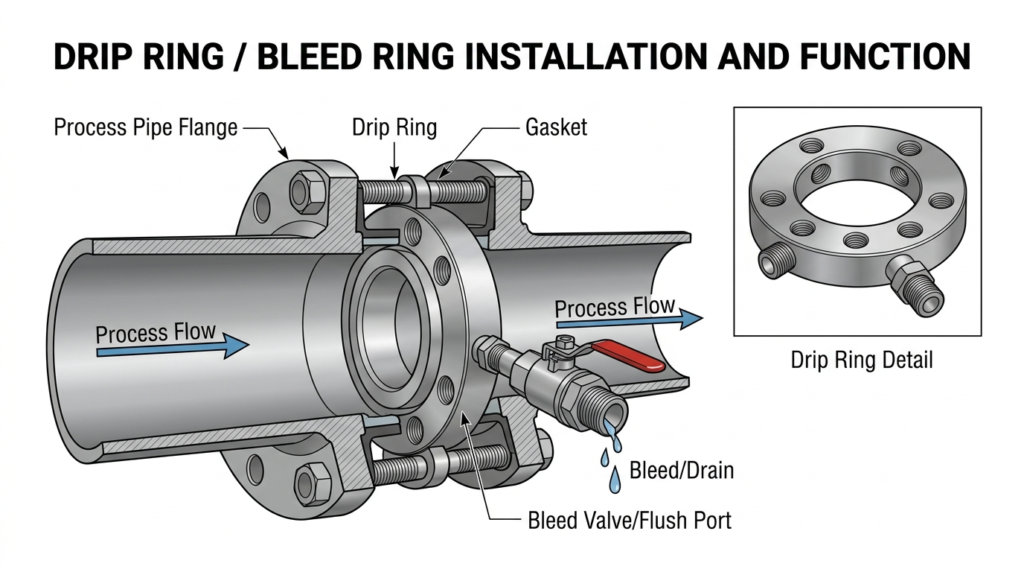
The functioning mechanism works as follows:
- Fluid flows through the pipeline under operational pressure
- The primary gasket seals the joint between the two flanges
- Minor leakage, if present, migrates toward the flange interface
- The drip ring’s radial port provides a controlled, visible outlet for escaping fluid
- Maintenance teams can identify, isolate, and address the leak without depressurizing the system
This mechanism is also commonly used in Double Block and Bleed (DBB) configurations, where the bleed ring provides a verification point to confirm that upstream isolation valves are sealing correctly.
Benefits of Drip Rings: Enhancing Pipeline Sealing and Preventing Leaks
Integrating drip rings into pipeline systems delivers advantages that go well beyond basic leakage control:
1. Enhanced Leakage Control
Drip rings function as a secondary containment layer, capturing escaping fluid before it spreads — minimising equipment contamination, reducing environmental hazards, and improving overall workplace safety.
2. Stable Pressure Maintenance
By limiting fluid loss, drip rings help maintain consistent internal pressure, ensuring smoother operations and reduced energy wastage caused by pressure fluctuations.
3. Superior Sealing Performance
When combined with gaskets such as spiral wound gaskets, drip rings strengthen the overall sealing assembly — lowering the chances of seal failure, especially under varying or dynamic operating conditions.
4. Lower Maintenance and Downtime
Drip rings enable early detection of leaks, allowing timely interventions, reducing unexpected failures, and ultimately lowering overall operational and repair costs.
5. No Hot Work Required
Drip rings can be retrofitted into existing flange joints without welding — making them safe to install in hazardous areas where hot work is restricted.
Drip Ring Usage Across Industrial Sectors
As part of advanced industrial sealing rings, drip rings are widely used in industries where sealing reliability is critical:
| Industry | Application |
| Oil and Gas | Prevent hazardous leaks in high-pressure pipelines; used in DBB valve configurations; ensures safety compliance |
| Chemical Processing | Manage corrosive fluid leakage; corrosion-resistant alloy options available |
| Water Treatment | Reduce water loss; improve distribution efficiency at flange joints |
| Power Plants & Refineries | Support sealing in high-temperature, high-pressure systems with steam condensate drainage |
| Petrochemicals | Instrument connection points for pressure gauges and thermowells in critical process lines |
Drip Rings vs Other Pipeline Sealing Solutions
| Aspect | Drip Rings (Bleed Rings) | Primary Gaskets / Seals |
| Function | Leakage monitoring & controlled drainage access | Primary pressure sealing between flange faces |
| Primary Role | Secondary containment & instrument port | Core sealing element |
| Leakage | Provides controlled outlet for minor leaks | Prevents leaks at primary joint |
| Failure Mode | Visible, early warning signs | Can fail suddenly under extreme conditions |
| Maintenance | Easier leak monitoring without shutdown | Requires periodic inspection and replacement |
| Best Used As | Complement to gaskets — adds a safety layer | Standalone sealing element |
When compared with traditional pipeline sealing solutions, drip rings provide a distinct advantage by enhancing leakage control and system monitoring rather than replacing primary sealing elements. Both work best when used together.
Why Choose IGP Engineers for Drip Rings and Bleed Rings
IGP Engineers — established in 1955 and India’s largest manufacturer and supplier of industrial gaskets — stands out as a trusted pipeline sealing solutions manufacturer delivering high-performance drip rings engineered for demanding industrial environments. Our key strengths include:
- Precision manufacturing backed by strict quality standards
- Strong customisation capabilities — tailored solutions for specific pipeline needs, pressure ratings, and media
- Versatile material options: carbon steel, stainless steel, alloy steel and exotic alloys
- Seamless compatibility with complementary sealing products including spiral wound gaskets, ring type joint gaskets, and monolithic insulation joints
- Export footprint across 66+ countries with a 70-year track record of reliability
Conclusion
Effective sealing is vital for safe and efficient pipeline operations. For engineers, procurement teams, and plant managers, investing in high-quality drip rings from IGP Engineers — one of the world’s most trusted sealing manufacturers since 1955 — ensures long-term reliability and operational excellence. Contact IGP Engineers for reliable, efficient, and long-lasting pipeline sealing solutions.
Frequently Asked Questions
1. What are drip rings used for in pipelines?
Drip rings (bleed rings) are used to capture and monitor leakage at flange joints, provide instrument connection points (pressure gauges, thermowells), and enable controlled fluid drainage — all without requiring system shutdown.
2. What is the difference between a drip ring and a bleed ring?
They are the same component referred to by different names. In most of the oil & gas and petrochemical industry, ‘bleed ring’ is the more common term. ‘Drip ring’ is typically used when the primary purpose is condensate drainage. Both are ring-shaped fittings installed between flanges with radial tapped ports.
3. What ASME standard applies to drip rings / bleed rings?
Drip rings are manufactured to be compatible with ASME B16.5 (flange dimensions and pressure ratings), ASME B16.48 (line blanks/spacer rings), and ASME B16.20 (ring joint gaskets) depending on the application and pressure class.
4. What size range do drip rings come in?
Standard drip rings are available from NPS ½” to NPS 24″ across ASME pressure classes 150 through 1500. Custom sizes are also available from IGP Engineers.
5. How do drip rings prevent leakage in flange joints?
Drip rings intercept escaping fluid and redirect it through a controlled radial port outlet, ensuring leakage is contained and immediately visible — preventing silent system contamination.
6. Are drip rings compatible with all gasket types?
Yes, drip rings are generally compatible with most industrial gaskets (spiral wound, RTJ, kammprofile, sheet gaskets) when properly sized and installed. Two standard gaskets are required — one on each side of the ring.
7. Which industries benefit most from drip rings?
Oil and gas, chemical processing, water treatment, power generation, and petrochemical industries benefit significantly due to high-pressure, high-temperature, or corrosive fluid handling requirements.
8. Do drip rings reduce maintenance costs in pipelines?
Yes. By enabling early leak detection and providing access for instruments and sampling, drip rings help prevent major failures and allow proactive maintenance — reducing overall maintenance costs and unplanned downtime.