
Industrial facilities depend on reliable sealing systems to maintain safe, efficient, and uninterrupted operations. However, when an industrial gasket failure occurs, the consequences can be severe, ranging from product loss and equipment damage to safety hazards and costly downtime. Even a minor sealing issue can result in huge failure. Understanding the common reasons behind gasket failure and implementing effective preventive measures can significantly improve equipment reliability and reduce maintenance costs.
This guide explores the leading gasket failure causes, practical prevention strategies, and maintenance best practices to help engineers and maintenance teams maximize sealing performance.
Why Gasket Failure Is a Critical Concern
Industrial gaskets are designed to create a secure seal between mating surfaces, preventing the escape of liquids, gases, and other process media. When a gasket fails, the integrity of the entire system can be compromised.
The Impact of Gasket Failure
Leaks involving hazardous chemicals, steam, hydrocarbons, or pressurized fluids can expose workers to dangerous conditions. In critical industries such as oil and gas or petrochemicals, a gasket failure may increase the risk of fires, explosions, and environmental contamination.
How Gasket Leakage Leads to Equipment Downtime
Unexpected gasket leakage often requires immediate shutdowns for inspection and replacement. Production interruptions can affect output targets, delay project timelines, and reduce operational efficiency.
The Hidden Cost of Frequent Repairs
Beyond replacement expenses, repeated gasket failures can result in labor costs, lost production time, equipment damage, and emergency maintenance activities. For many facilities, these indirect costs far exceed the cost of the gasket itself.
What Is Industrial Gasket Failure?
An industrial gasket failure occurs when a gasket can no longer maintain the intended seal between two surfaces under specified operating conditions.
How Industrial Gaskets Function
Industrial gaskets are compressed between flange faces or equipment components to fill surface irregularities and create a leak-proof barrier. Their performance depends on proper material selection, installation, operating conditions, and maintenance practices.
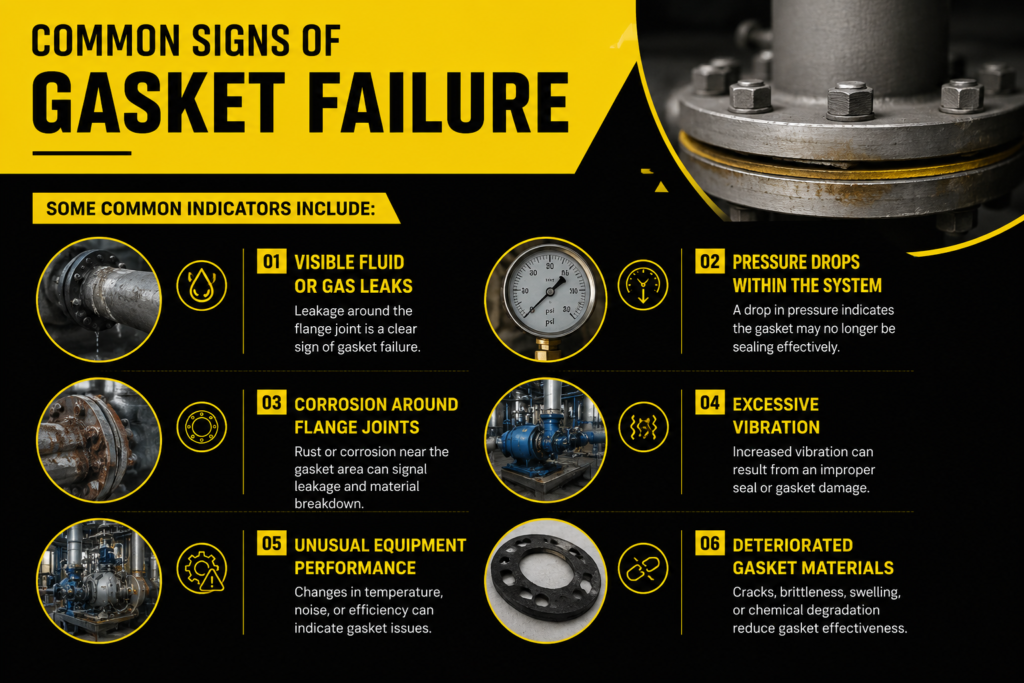
Common Signs of Gasket Failure
Some common indicators include:
- Visible fluid or gas leaks
- Pressure drops within the system
- Corrosion around flange joints
- Excessive vibration
- Unusual equipment performance
- Deteriorated gasket materials
Why Early Detection Matters
Detecting problems early can prevent a minor issue from escalating into a major operational failure. Regular inspections help maintenance teams identify warning signs before complete sealing failure occurs.
The Most Common Causes of Gasket Failure
Most gasket failure causes can be traced back to a combination of installation errors, material incompatibility, operational stress, and environmental factors.
1. Improper Installation and Incorrect Bolt Tightening
Improper installation is one of the leading causes of gasket failure. Common mistakes include:
- Uneven bolt tightening
- Incorrect torque application
- Flange misalignment
- Contaminated sealing surfaces
When bolt loads are unevenly distributed, the gasket may experience localized overstressing or inadequate compression, leading to premature leakage.
Prevention: Follow manufacturer torque specifications, use calibrated tightening tools, apply proper bolt tightening sequences, and ensure clean, flat flange surfaces.
2. Selecting the Wrong Gasket Material
Material compatibility is critical to sealing performance. Choosing a gasket that can’t withstand the operating temperature, pressure, or chemical environment often leads to rapid deterioration — for example, a gasket exposed to aggressive chemicals without proper resistance may swell, crack, or degrade over time.
Prevention: Evaluate process media compatibility, factor in operating temperatures and pressures, and consult sealing specialists during material selection.
3. Excessive Temperature Exposure
Extreme temperatures can negatively affect gasket materials by causing hardening, softening, thermal degradation, or loss of elasticity.
Repeated thermal cycling may also accelerate wear and reduce sealing effectiveness.
Prevention:
- Use temperature-resistant gasket materials
- Monitor process temperatures continuously
- Select gaskets specifically engineered for high-temperature environments
4. High Pressure and Mechanical Stress
Industrial systems often operate under demanding pressure conditions. Excessive pressure can cause gasket extrusion, blowouts, or structural deformation, while vibration, fluctuating loads, and equipment movement add further mechanical stress.
Prevention: Choose pressure-rated sealing products, verify flange integrity, minimize vibration where possible, and conduct regular joint inspections.
5. Chemical Attack and Corrosion
Aggressive chemicals can gradually weaken gasket materials, reducing their ability to maintain an effective seal. Corrosive environments may also damage flange surfaces, making sealing increasingly difficult.
Prevention: Use chemically resistant materials, inspect process systems regularly, address corrosion issues promptly, and apply protective coatings where necessary.
6. Aging, Wear, and Environmental Factors
Even properly installed gaskets have a finite service life. Exposure to moisture, UV radiation, oxidation, and environmental contaminants can gradually degrade sealing performance.
Prevention: Establish replacement schedules, store gaskets properly before installation, and monitor aging components during inspections.
How Gasket Leakage Affects Equipment Performance
Reduced Operational Efficiency
Persistent gasket leakage can lead to energy losses, pressure inefficiencies, and reduced equipment performance. Systems may require additional power to maintain operating conditions, increasing overall operational costs.
Increased Maintenance Requirements
Leak-related issues often require frequent inspections, repairs, and component replacements. Maintenance teams may spend significant resources addressing recurring sealing problems instead of focusing on preventive initiatives.
Safety and Environmental Risks
Uncontrolled gasket leakage involving hazardous substances can create compliance concerns and increase workplace safety risks. Environmental regulations often require immediate corrective action to prevent contamination.
Root Cause vs Prevention: How Can Industrial Gasket Failure Be Avoided?
The following table summarizes common failure mechanisms and corresponding preventive measures:
|
Root Cause |
Impact | Prevention Method |
|
Improper installation |
Leakage and uneven compression |
Correct torque procedures and trained personnel |
|
Material incompatibility |
Chemical degradation |
Proper material selection |
| Excessive temperature | Thermal damage |
High-temperature gasket materials |
|
High pressure |
Blowouts and deformation |
Pressure-rated gasket designs |
|
Corrosion |
Surface damage and leakage |
Corrosion-resistant materials and inspections |
| Aging and wear | Reduced sealing effectiveness |
Scheduled replacement programs |
Implementing these strategies is fundamental to successful gasket failure prevention and long-term operational reliability.
Industry Standards That Improve Gasket Reliability
Standards such as ASME B16.20, ASME B16.21, and ASME PCC-1 provide guidance on gasket dimensions, materials, and bolted flange joint assembly procedures. The American Petroleum Institute (API) offers additional recommendations for sealing systems used in demanding environments, particularly in oil and gas. Following these standards promotes consistent installation quality, improved sealing performance, reduced maintenance issues, and enhanced plant safety.
Best Practices for Industrial Gasket Maintenance
- Conduct regular visual inspections for leaks, material degradation, corrosion, and mechanical damage
- Monitor temperature, pressure, and process conditions continuously
- Inspect flange surface conditions — a damaged or corroded flange face compromises even a high-quality gasket
- Implement preventive maintenance schedules to reduce emergency repairs
- Maintain accurate inspection and replacement records to spot recurring issues
How Precision Engineering Improves Gasket Performance
The reliability of an industrial sealing system depends heavily on manufacturing quality and engineering precision. Material selection determines resistance to temperature, pressure, and chemical exposure, while dimensional accuracy ensures consistent compression characteristics — even minor dimensional variations can affect sealing efficiency. Complex systems often need sealing solutions tailored to their specific operating conditions, which is where custom engineering outperforms generic alternatives.
Gasket Maintenance Checklist
- Inspect flange joints regularly for leaks
- Verify bolt torque during maintenance activities
- Monitor temperature and pressure conditions
- Confirm gasket compatibility with process media
- Check flange surfaces for corrosion and damage
- Replace aged or worn gaskets proactively
- Follow ASME installation guidelines
- Maintain inspection and replacement records
- Train maintenance personnel on proper installation technique
- Consult sealing experts for critical applications
Key Takeaways
- Improper installation and material mismatch are among the leading causes of gasket failure
- Gasket leakage can result in downtime, safety risks, and costly repairs
- Industry standards help improve sealing performance and reliability
- Preventive inspections are essential to any gasket maintenance program
- Precision-engineered gaskets contribute to long-term operational efficiency
Why IGP Engineers
Most gasket failures are avoidable — through proper material selection, correct installation, routine inspection, and proactive maintenance. At IGP Engineers, we build on decades of experience across metallic, semi-metallic, and non-metallic gaskets, working closely with customers to understand their operating conditions and deliver sealing solutions engineered for demanding industrial environments. Our focus isn’t just supplying gaskets — it’s helping industries run safer operations, cut downtime, and extend equipment life through material expertise, precision manufacturing, and rigorous quality control.
Talk to our sealing specialists about a gasket solution engineered for your operating conditions.