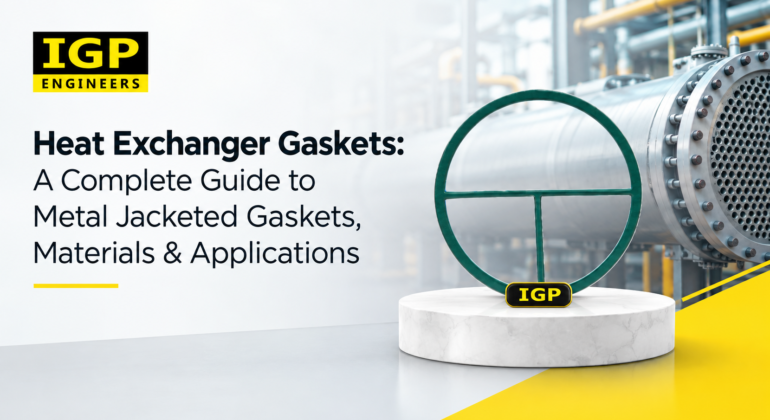

Heat exchangers operate under demanding combinations of temperature, pressure and fluid movement, making reliable sealing essential for safe and efficient operation. Heat exchanger gaskets create a controlled seal between mating surfaces, preventing process fluids from leaking or mixing while helping maintain the intended heat-transfer performance.
An unsuitable gasket can result in leakage, contamination, pressure loss, unplanned shutdowns and costly maintenance. For equipment manufacturers, plant maintenance engineers and procurement teams, gasket selection therefore requires more than simply matching dimensions.
The gasket must be compatible with the process media, operating temperature, pressure, flange design, surface condition and expected service conditions.
What Are Heat Exchanger Gaskets?
Heat exchanger gaskets are sealing components installed between mating sections of heat exchanger equipment to prevent leakage and keep separate process fluids from mixing. Depending on the heat exchanger design and operating conditions, different gasket constructions and materials may be required.
In a typical heat exchanger, two fluids may exchange thermal energy while remaining physically separated. A reliable gasket maintains the seal around the joint so that water, oil, refrigerants, steam or other process fluids remain within their designated passages.
Why Gaskets Are Essential for Heat Exchanger Sealing
Effective heat exchanger sealing helps maintain pressure integrity while preventing cross-contamination between process streams. A gasket must accommodate minor surface irregularities and maintain contact under the operating conditions of the equipment.
Poor sealing can lead to fluid loss, reduced thermal performance and frequent maintenance. For this reason, gasket selection should consider the complete operating environment rather than focusing only on gasket size or material.
How Do Heat Exchanger Gaskets Work?
A gasket works by being compressed between mating surfaces, filling microscopic irregularities and creating a continuous barrier against fluid escape. The required sealing performance depends on gasket construction, compression, flange condition and available bolting load.
i) Compression and Sealing Between Flange Surfaces
During assembly, bolts apply load to the joint and compress the gasket. The gasket material conforms to the mating surfaces, helping close potential leakage paths. Correct and uniform compression is essential because insufficient or uneven loading can create areas where fluid can escape.
ii) Maintaining Sealing Performance Under Temperature and Pressure
A gasket must retain its sealing characteristics as the equipment heats, cools and operates under pressure. Thermal expansion, vibration and pressure fluctuations can place additional demands on the joint.
What is a Metal Jacketed Gasket?
A metal jacketed gasket combines a soft, compressible filler or core with a protective metallic jacket. The filler provides compressibility and sealing capability, while the metal jacket provides structural support and protects the core against mechanical stress, temperature changes and chemical exposure.
IGP manufactures metal jacketed gaskets for heat exchanger applications and can also manufacture open-edged double-jacketed designs, where the core is enclosed by a two-piece metal jacket except at the outer edge.
Construction of a Metal Jacketed Gasket
The construction generally consists of two functional components:
- Metal jacket: Provides mechanical protection, durability and resistance to the operating environment.
- Soft filler/core: Provides compressibility and helps the gasket conform to mating surfaces.
How the Metal Jacket and Filler Work Together
The combination allows the gasket to balance structural strength with sealing flexibility. The metal jacket protects the filler, while the compressible core helps create an effective seal when the joint is properly loaded. This construction makes metal jacketed gaskets useful for equipment exposed to demanding temperature and pressure conditions.
Advantages of Metal Jacketed Gaskets for Heat Exchangers
- Robust metallic protection
- Compressible sealing core
- Multiple jacket and filler combinations
- Suitability for demanding operating conditions
- Customizable construction for equipment requirements
Materials and Fillers Used in Metal Jacketed Gaskets
Material selection is one of the most important considerations when choosing a high temperature gasket or a gasket intended for pressurized service. The jacket and filler should be selected according to process media, temperature, pressure, flange characteristics and service conditions.
Common Metal Jacket Materials
IGP identifies several jacket materials for metal jacketed constructions, including soft iron, low carbon steel, Monel, aluminium, copper, brass, cupronickel, Inconel 600, Inconel 800 and various stainless steel grades.
The appropriate material depends on the application. Corrosion resistance, mechanical requirements, temperature exposure and fluid compatibility should all be evaluated before final selection.
Common Filler Materials
Filler options listed by IGP include CAF, non-asbestos materials, PTFE and Grafoil, along with other specified filler constructions.
The filler plays an important role in compressibility and sealing performance. For a high pressure gasket, the filler and jacket combination must be capable of maintaining an effective seal under the expected mechanical and thermal conditions.
How to Choose the Right Jacket and Filler Combination
There is no single material combination suitable for every application. Engineers should evaluate the process fluid, operating and peak temperatures, pressure, flange design, joint loading and environmental conditions before selecting the gasket.
Heat Exchanger Gasket Types: Metal Jacketed vs Corrugated vs Spiral Wound
Understanding heat exchanger gasket types helps engineers select a construction that matches their equipment and operating conditions. Typical industry-published operating ranges are shown below — always confirm against tested ratings for the specific material combination and application.
|
Gasket Type |
Temperature Capability | Pressure Capability | Typical Applications |
|
Metal Jacketed |
High | High |
Heat Exchangers |
|
Corrugated Metal |
High | Medium-High |
Boilers, Heat Exchangers |
| Spiral Wound | Very High | Very High |
Refineries, Petrochemicals |
Which Heat Exchanger Gasket Type Should You Choose?
The appropriate heat exchanger gasket type depends on flange construction, available sealing load, media, temperature, pressure, vibration and service conditions. Consulting a specialist manufacturer can help avoid selecting a gasket solely on dimensional compatibility.
What Is the Best Gasket Material for Heat Exchangers?
For most heat exchanger applications, stainless steel jacketed gaskets with a Grafoil or PTFE filler offer the best balance of temperature resistance, chemical compatibility and cost. Inconel jackets are preferred for higher-temperature or more corrosive services, while PTFE-filled constructions suit aggressive chemical media. The right choice ultimately depends on the specific temperature, pressure, process media and flange conditions of the application.
How to Select the Right Gasket for a Heat Exchanger
Choosing the right gasket requires evaluating the complete operating environment.
i) Consider Operating Temperature
Identify both normal operating temperature and peak temperature. Repeated heating and cooling can also affect gasket performance, so thermal cycling should be considered.
ii) Evaluate Operating Pressure
The gasket should be suitable for the system’s normal and maximum pressure. Pressure fluctuations should also be considered when selecting a high pressure gasket.
iii) Check Chemical Compatibility
Water, oil, refrigerants, steam, hydrocarbons and chemicals can impose different compatibility requirements. The jacket and filler should not deteriorate when exposed to the process fluid.
iv) Consider Flange Design
Flange geometry, surface finish, flatness and condition influence sealing performance. Damaged or contaminated mating surfaces can compromise even a correctly selected gasket.
v) Account for Thermal Cycling, Vibration and Sealing Load
Equipment exposed to vibration, changing temperatures or varying pressure requires careful gasket selection. IGP specifically highlights these factors as part of its equipment-gasket selection approach.
Ensure reliable heat exchanger sealing with the right gasket selection. Consult IGP Engineers to identify a solution engineered around your operating temperature, pressure, media compatibility and equipment design.
Applications of Industrial Heat Exchanger Gaskets
Industrial heat exchanger gaskets are used wherever heat-transfer equipment must maintain separation between process fluids. Common applications include:
|
Industry / Application |
Purpose |
|
Oil & Gas Facilities |
Prevent leakage in heat exchanger systems |
|
Refineries & Petrochemical Plants |
Ensure reliable sealing in process operations |
| Chemical Processing Units |
Handle corrosive fluids and chemicals safely |
|
Power Generation Facilities |
Support efficient heat transfer equipment |
|
Steam & Boiler Systems |
Maintain pressure and fluid containment |
| Industrial Process Plants |
Improve sealing reliability across operations |
|
Heat Exchanger Manufacturing & Maintenance |
Used for equipment assembly and servicing |
| Pumps, Columns & Process Equipment |
Provide dependable sealing under demanding conditions |
IGP’s equipment-gasket portfolio specifically includes heat exchanger, metal jacketed and corrugated metal gasket solutions, alongside kammprofile and spiral wound gaskets.
Common Causes of Heat Exchanger Gasket Failure
Gasket failure is often caused by a combination of selection, installation and operating issues.
Incorrect Gasket Material Selection
Using a filler or jacket that is incompatible with the process fluid or temperature can accelerate deterioration and leakage.
Excessive Temperature or Pressure
Operating beyond the suitable service conditions can reduce sealing reliability and shorten gasket life.
Improper Compression and Bolt Loading
Uneven or insufficient compression may leave leakage paths, while inappropriate loading can damage the gasket or joint.
Damaged or Improperly Prepared Flanges
Corrosion, scratches, distortion, contamination and surface irregularities can prevent proper gasket seating.
Incorrect Installation and Maintenance
Poor alignment, improper tightening procedures or reusing unsuitable gasket components can contribute to premature failure.
How Long Do Heat Exchanger Gaskets Last?
Heat exchanger gasket lifespan depends on operating conditions, gasket material and maintenance practices. Under normal, well-controlled operating conditions, a correctly selected metal jacketed gasket can provide reliable service for several years between scheduled maintenance intervals. Excessive temperature, pressure or chemical exposure — or poor installation practice — can shorten this significantly, sometimes to a single operating cycle.
Installation and Maintenance Tips
Before installation, inspect and clean the mating surfaces and verify that the gasket dimensions and materials match the equipment specification.
Inspect and Prepare Flange Surfaces
Remove contaminants and check for damage, distortion or excessive irregularities before installing the gasket.
Ensure Correct Gasket Alignment
Position the gasket accurately and ensure that compression is distributed appropriately across the joint.
Follow Proper Bolting Procedures
Use an appropriate tightening sequence — typically a star or cross pattern applied in multiple incremental passes — and controlled bolt loading to achieve consistent compression.
Inspect for Leakage During Operation
After commissioning and during routine maintenance, monitor the joint for signs of leakage or abnormal operating behaviour. Early detection can prevent more extensive equipment problems.
Why Industries Trust IGP Engineers for Heat Exchanger Gaskets
Selecting the right gasket partner is just as important as choosing the right gasket itself. With over seven decades of expertise in sealing technology, IGP Engineers has established itself as a trusted manufacturer of engineered gasket solutions for demanding industrial environments.
Rather than offering standardized products, IGP focuses on delivering application-driven sealing solutions designed to meet the unique operating conditions of each customer.
The IGP Engineers Advantage
- 70+ Years of Sealing Expertise – A long-standing legacy in industrial gasket manufacturing backed by extensive application knowledge across diverse industries.
- Comprehensive Equipment Gasket Portfolio – Specialized manufacturing of heat exchanger gaskets, metal jacketed gaskets, corrugated metal gaskets, spiral wound gaskets and other engineered sealing solutions.
- Application-Oriented Engineering Support – Gasket recommendations based on operating temperature, pressure, media compatibility, flange conditions and sealing requirements.
- Advanced Manufacturing Infrastructure – Modern production facilities equipped with dedicated manufacturing, quality assurance and process control systems.
Whether the requirement is for standard industrial applications or highly customized sealing solutions, IGP combines technical expertise, manufacturing capability and application knowledge to deliver dependable gasket solutions for critical industrial operations.
Choose the Right Heat Exchanger Gasket Manufacturer
Reliable sealing begins with selecting the right gasket for the actual equipment and operating environment. Whether the requirement involves metal jacketed, corrugated metal or another engineered construction, material compatibility, joint design, temperature, pressure and installation conditions should guide the decision.
With more than seven decades of industrial gasket expertise, dedicated heat exchanger gasket manufacturing capabilities, broad material options and advanced manufacturing infrastructure, IGP Engineers provides application-focused sealing solutions for demanding industrial environments.
Looking for reliable heat exchanger gaskets? Contact IGP Engineers to discuss your equipment specifications, operating conditions and sealing requirements.
FAQ’s
What is the difference between a metal jacketed gasket and a spiral wound gasket?
A metal jacketed gasket uses a soft filler fully or partially enclosed in a solid metal jacket, giving it strong mechanical protection and good performance in moderate-to-high pressure heat exchanger joints. A spiral wound gasket alternates metal winding with filler material in a spiral pattern, giving it greater flexibility and typically higher temperature and pressure capability, which is why it’s more common in refinery and petrochemical piping.
Can metal jacketed gaskets be reused?
No. Metal jacketed gaskets are designed for single use. Once a joint is broken, the filler has already taken a compression set and the jacket may be deformed, so reusing the gasket risks an incomplete seal and leakage on re-installation.
What causes a heat exchanger gasket to leak?
The most common causes are incorrect material selection for the process fluid or temperature, uneven or insufficient bolt-torque compression, and damaged or contaminated flange surfaces. Operating beyond the gasket’s rated temperature or pressure is another frequent cause.
How do I know if I need a metal jacketed or corrugated metal gasket?
Metal jacketed gaskets are generally preferred where the filler needs maximum protection from an aggressive process fluid, such as in heat exchanger channel covers. Corrugated metal gaskets are often chosen where the flange has less available bolt load, since the corrugations help the gasket seal effectively under lighter compression.
What industries use heat exchanger gaskets most?
Oil & gas, refining and petrochemical processing, power generation, and chemical processing are the largest users of heat exchanger gaskets, since all four rely heavily on heat-transfer equipment operating under high temperature and pressure.