
In the world of industrial operations, maintaining leak-free pipelines, valves, and pressure systems is crucial. A small gasket failure can lead to costly downtime, safety hazards, or even environmental damage. This is where spiral wound gaskets play a pivotal role. Renowned for their durability and versatility, they are engineered to withstand high pressures, extreme temperatures, and challenging chemical environments. IGP Engineers, a leading industrial gaskets manufacturer and supplier, offers a wide range of high-quality spiral wound gaskets customized for industrial needs.
This guide will help industrial engineers, mechanical engineers, and procurement managers understand the different types of spiral wound gaskets, their applications, and how to choose the right one for your operations.
Why Are Spiral Wound Gaskets Essential?
Spiral wound gaskets are designed to provide a tight seal between two flange faces, preventing leaks in high-pressure and high-temperature environments.
These gaskets combine the resilience of a metal strip with the flexibility of a soft filler material such as graphite or PTFE, allowing them to maintain a secure seal even under fluctuating conditions.
Industries rely on spiral wound gaskets in applications such as:
- Oil & gas pipelines
- Chemical processing units
- Power plants
- Petrochemical refineries
- Steam lines and heat exchangers
Using the wrong gasket type, low-quality materials, or improperly sized gaskets can result in leakage, equipment damage, or operational downtime.
Industrial engineers often face challenges when trying to select the correct gasket type due to complex technical specifications, diverse material options, and high-pressure requirements.
Common Gasket Challenges in Industry
Selecting the right gasket is more than just choosing a size, it requires understanding materials, flange standards, pressure ratings, and chemical compatibility. Some of the most common pain points include:
Confusion About Gasket Types:
With numerous gasket designs, engineers may struggle to identify the correct gasket types for their application. Choosing incorrectly can compromise the seal and system integrity.
Low-Quality Gaskets Fail Under Pressure:
Substandard gaskets may deform or fail under high temperatures or pressures, causing leaks and operational downtime.
Complex Technical Specifications:
Understanding metrics such as pressure ratings, flange compatibility, and chemical resistance can be overwhelming without expert guidance.
Industrial case scenarios highlight these challenges. For example, a chemical plant using incompatible metal gaskets experienced repeated leakage in high-pressure pipelines, resulting in production delays and costly maintenance.
Tips for Selecting the Right Spiral Wound Gasket
Selecting the right spiral wound gasket involves more than just matching sizes:
- Evaluate Pressure and Temperature Requirements: Ensure the metal gaskets can handle operating conditions.
- Consider Chemical Compatibility: Choose fillers like graphite or PTFE based on the chemical nature of the fluid in the pipeline.
- Check Flange Type and Surface Finish: Internal or external wound gaskets may be required for specific flange configurations.
- Consult Experts: IGP Engineers provide guidance and custom solutions for industrial sealing needs.
By carefully considering these factors, engineers and procurement managers can select industrial sealing solutions that maximize performance and minimize operational risks.
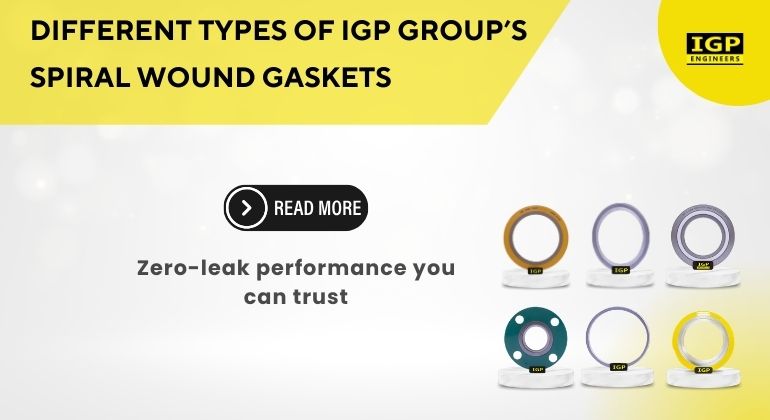
Types of Spiral Wound Gaskets – IGP Group
IGP Engineers offers a wide range of spiral wound gaskets designed to meet diverse industrial requirements.
1. SOR – Spiral Wound Gasket with Outer Ring

- Design: Features a spirally wound metal strip with a soft filler material, enclosed within an outer ring.
- Functionality: The outer ring serves as a centering device and limits the radial flow of the gasket upon compression, enhancing its resilience.
- Applications: Ideal for high-pressure and high-temperature environments such as petrochemical plants, refineries, and power generation systems.
- Benefits: Provides robust sealing capabilities, preventing over-compression and ensuring a leak-proof joint.
2. SIR – Spiral Wound Gasket with Inner Ring

- Design: Similar to the SOR type but includes an inner ring that provides additional strength and stability to the gasket.
- Functionality: The inner ring prevents the gasket from being over-compressed, maintaining its integrity under high-pressure conditions.
- Applications: Suitable for applications where the gasket is exposed to extreme pressures and temperatures, requiring enhanced structural support.
- Benefits: Offers improved sealing performance and durability, reducing the risk of gasket failure.
3. SIO – Spiral Wound Gasket with Inner and Outer Rings

- Design: Combines both inner and outer rings with a spirally wound metal strip and soft filler material.
- Functionality: The dual-ring design provides maximum strength, stability, and resilience, ensuring a reliable seal under the most demanding conditions.
- Applications: Recommended for critical applications in industries such as oil & gas, chemical processing, and high-pressure steam systems.
- Benefits: Delivers superior sealing performance, preventing leakage and enhancing operational safety.
4. SIOH – Spiral Wound Gasket with Inner and Outer Rings with Bolt Holes
- Design: Features inner and outer rings with bolt holes, facilitating precise alignment and secure installation.
- Functionality: The bolt holes in the outer ring allow for accurate positioning during assembly, ensuring a stable and leak-proof joint.

- Applications: Suitable for applications where precise gasket placement is critical, such as in high-pressure pipelines and pressure vessels.
- Benefits: Enhances installation efficiency and gasket performance, reducing the risk of misalignment and potential leaks.

5. SWR – Spiral Wound Gasket without Inner and Outer Rings

- Design: Consists of a spirally wound metal strip with a soft filler material, without any additional rings.
- Functionality: The gasket relies on the compression of the metal strip and filler material to form a seal.
- Applications: Commonly used in flanged joints with grooves or other features that ensure proper gasket location and compression.
- Benefits: Offers flexibility in applications where ringed gaskets are not required, providing cost-effective industrial sealing solutions.
6. SCD – Spiral Wound Gasket with Centering Device

- Design: Incorporates a centering device, typically an internal metal or plastic ring, to ensure proper alignment between the flanges.
- Functionality: The centering device aids in the accurate positioning of the gasket during installation, preventing misalignment.
- Applications: Ideal for installations in high-hazard zones where quick and accurate gasket placement is essential.
- Benefits: Facilitates efficient installation and reliable sealing, reducing the likelihood of leaks and operational disruptions.
Spiral Wound Gasket Comparison Table
| Type | Design | Use | Benefit |
| Spiral Wound Gasket with Outer Ring | Outer ring | High pressure/temp | Strong, leak-proof |
| Spiral Wound Gasket with Inner Ring | Inner ring | Extreme conditions | Durable, reliable |
| Spiral Wound Gasket with Inner and Outer Rings | Inner + outer rings | Oil & gas, chemicals | Superior seal |
| Spiral Wound Gasket with Inner and Outer Rings with Bolt Holes | Dual rings + bolt holes | High-pressure pipelines | Accurate fit, less leaks |
| Spiral Wound Gasket without Inner and Outer Rings | No rings | Flanged joints | Flexible, cost-effective |
| Spiral Wound Gasket with Centering Device | Centering device | Precise installations | Easy alignment, reliable |
Real-World Industrial Applications
Case Scenario: Chemical Processing Units
In chemical plants, pipelines may carry highly corrosive fluids. Internal and external wound gaskets, crafted from stainless steel and graphite, provide reliable sealing while resisting chemical attack. These metal gaskets ensure consistent performance, even in aggressive chemical environments.
This demonstrates how selecting the correct IGP gasket can prevent operational failures, enhance safety, and optimize industrial efficiency.
Benefits of Choosing IGP Group Spiral Wound Gaskets
- High-Quality Materials and Precision Manufacturing:
IGP Engineers use premium-grade metals and fillers to ensure that gaskets meet international standards and withstand rigorous industrial conditions. - Customizable Solutions:
Whether it’s flange size, material combination, or pressure rating, IGP gaskets can be tailored to specific industrial requirements. - Certified and Reliable:
IGP gaskets are manufactured under strict quality protocols and certifications, ensuring compliance with global industrial standards. - Technical Support:
Expert guidance is available to help engineers select the right gasket type, material, and configuration for their industrial sealing solutions.
Final Words
IGP Engineers, as a leading industrial gaskets manufacturer, offers a wide range of high-quality spiral wound gaskets designed for various industrial applications. With precision engineering, superior materials, and customized solutions, IGP gaskets deliver reliable performance even in the most demanding environments.
For industrial engineers and procurement managers seeking dependable sealing solutions, and gasket types contacting IGP Engineers is the first step toward ensuring leak-free, efficient operations.
Contact us to explore the full range of spiral wound gaskets for your operational needs.
FAQ: Choosing the Right IGP Spiral Wound Gasket
- What are spiral wound gaskets used for?
Spiral wound gaskets are used to seal flanges in high-pressure and high-temperature pipelines, preventing leaks in industrial systems like oil & gas, chemical processing, and power plants. - How do I choose the right IGP gasket for my application?
Consider pressure, temperature, chemical compatibility, and flange type. IGP Engineers also provide expert guidance to select the most suitable industrial sealing solutions. - What materials are used in metal spiral wound gaskets?
Common materials include stainless steel (SS304, SS316), alloy steel, Inconel, and fillers like graphite or PTFE for chemical resistance and flexibility. - Can IGP gaskets handle high-temperature and high-pressure systems?
Yes, our Spiral wound gaskets are specifically designed to withstand extreme pressures and temperatures in industrial environments. - Are custom spiral wound gaskets available for specific industrial requirements?
Yes, IGP Engineers offer customizable gasket types to meet unique industrial specifications, including size, material, and pressure ratings.