
Introduction
Heat exchanger gasket failures can cause costly shutdowns, leakage, pressure loss, and safety risks in refineries and process industries. When evaluating spiral wound vs kammprofile gasket heat exchanger applications, engineers must consider thermal cycling, flange condition, pressure rating, and lifecycle cost.
Understanding the performance differences between these industrial gasket types helps plants improve sealing reliability and optimize long-term operational efficiency.
The Need for Gaskets in the Heat Exchanger
Heat exchangers operate under continuously changing pressure and temperature conditions. These sudden heat and pressure fluctuations create expansion and contraction within piping systems and flanges, placing constant stress on gasket sealing surfaces, which may lead to bigger failure.
Modern industries increasingly compare different heat exchanger gasket types to achieve higher operational reliability while controlling lifecycle costs. A proper gasket selection pressure temperature rating analysis helps engineers avoid premature sealing failures in critical process environments.
Understanding Heat Exchanger Gasket Types
Metallic gaskets are widely used in heat exchangers because they can withstand aggressive process conditions far beyond the capability of soft sheet gaskets. Among various heat exchanger gasket types, spiral wound and kammprofile gaskets are the most preferred choices for refinery and petrochemical services.
The gasket designs are primarily engineered for:
- High-pressure systems
- Elevated temperatures
- Corrosive media
- Thermal cycling applications
- Critical sealing environments
However, their construction methods and sealing characteristics differ significantly, making each suitable for specific operating conditions. Understanding these differences is essential when selecting a high pressure gasket for heat exchanger systems.
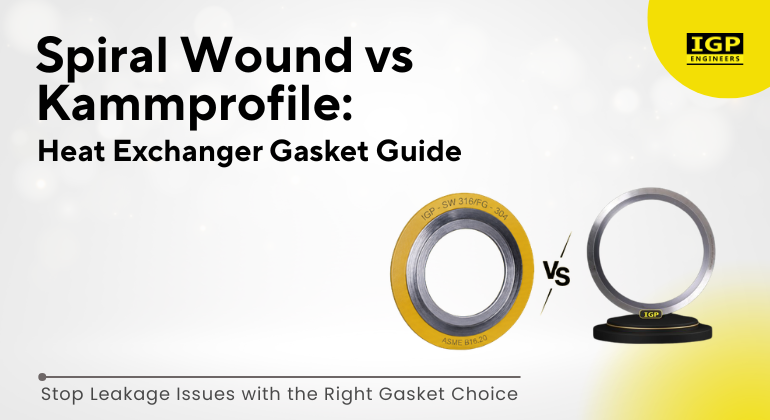
What is a Spiral Wound Gasket?
Construction
A spiral wound gasket is constructed using alternating layers of preformed metallic winding strips and soft filler materials wound together under controlled tension. The metal strip provides mechanical strength and resilience, while the filler material ensures effective sealing by conforming to flange surface irregularities. This design plays a key role in gasket selection pressure temperature rating, as it allows the gasket to perform reliably across varying pressure conditions and elevated temperatures in industrial applications.
Depending on the application, spiral wound gaskets may include an inner ring, outer centering ring, or both for improved stability and pressure resistance. Common metal materials include SS 316, SS 304, Inconel, and Monel, while filler options typically include graphite, PTFE, vermiculite, and ceramic materials for high-temperature and corrosive service applications.
Advantages
One of the biggest advantages of this spiral wound gasket selection guide is its flexibility across multiple industrial applications. These gaskets perform exceptionally well in standard refinery heat exchangers, steam systems, and hydrocarbon processing units.
- Excellent resilience under fluctuating loads
- Cost-effective sealing solution
- Good recovery during thermal expansion
- Suitable for high-pressure applications
- Wide material compatibility
Limitations
- Less effective on damaged flanges
- Higher risk of flange surface indentation
- Requires proper bolt load distribution
For plants operating under moderate-to-high pressure conditions with well-maintained flanges, spiral wound gaskets remain a highly economical choice.
What is a Kammprofile Gasket?
Construction
A Kammprofile gasket is constructed using a solid metal core with precision-machined concentric serrations on both sealing surfaces. The serrated core is typically manufactured from materials such as SS 316, carbon steel, Monel, or Inconel, depending on the application requirements.
The serrated design concentrates sealing stress across the flange surface, enabling excellent sealing performance under high pressure, elevated temperatures, and severe thermal cycling conditions in industrial heat exchanger applications.
Advantages
A major advantage of kammprofile gasket application environments is the gasket’s ability to maintain superior sealing performance under severe thermal cycling and fluctuating bolt loads.
- Exceptional leakage control
- Better flange protection
- Superior recovery capability
- Effective sealing on uneven flange surfaces
- High blowout resistance
Limitations
- Higher initial cost
- Over-specification for standard services
- Requires precision manufacturing
In critical refinery operations, kammprofile gaskets are widely preferred as a premium high pressure gasket for heat exchanger applications involving hazardous fluids and aggressive operating conditions.
Spiral Wound vs Kammprofile Gasket Heat Exchanger Comparison
Selecting between these gasket technologies requires a detailed engineering evaluation. In many refinery environments, the debate around spiral wound vs kammprofile gasket heat exchanger performance depends on operating severity and maintenance expectations.
| Parameter | Spiral Wound Gasket | Kammprofile Gasket |
| Pressure Capability | High | Very High |
| Temperature Range | Up to 1000°C | Above 1000°C |
| Thermal Cycling Resistance | Excellent | Superior |
| Leakage Control | Very Good | Exceptional |
| Flange Protection | Moderate | Excellent |
| Damaged Flange Suitability | Limited | Excellent |
| Cost | Economical | Premium |
| Blowout Resistance | Good | Superior |
| Reusability | Moderate | Moderate |
| Bolt Load Sensitivity | Medium | Lower |
This ASME gasket comparison clearly shows that kammprofile gaskets deliver better sealing performance under severe operating conditions, while spiral wound gaskets offer better cost efficiency for standard services.
From a metallic gasket flange compatibility perspective:
- Spiral wound gaskets perform best on properly machined flanges
- Kammprofile gaskets can tolerate flange imperfections more effectively
Overall, the high pressure gasket for heat exchanger becomes especially important in aging refinery infrastructure where flange damage is common.
Which Gasket Performs Better Under Thermal Cycling?
Thermal cycling is a major contributor to gasket leakage in heat exchangers, especially during startup and shutdown operations where repeated expansion and contraction create fluctuating sealing loads. In an ASME gasket comparison, understanding how different gasket types respond to these cyclic stresses is essential for selecting a reliable sealing solution.
In a typical kammprofile gasket application, the serrated metal core provides stronger load retention and lower relaxation over time. This enables the gasket to maintain sealing integrity even during aggressive temperature fluctuations.
Spiral wound gaskets also perform well under thermal cycling because of their elastic winding structure. However, under severe cyclic conditions, they may experience Filler degradation, Load loss and reduced sealing efficiency
This is why many engineers prefer kammprofile designs for:
- Critical hydrocarbon service
- High-temperature exchangers
- Hydrogen systems
- Toxic fluid handling
For standard industrial operations, the spiral wound gasket selection guide still recommends spiral wound gaskets because they provide excellent performance at lower cost.
How to Choose the Right Gasket for Your Heat Exchanger
Choosing between spiral wound and kammprofile gaskets depends on operating severity, maintenance priorities, and budget considerations.
Choose Spiral Wound Gaskets If:
Spiral wound gaskets are ideal for applications with moderate operating conditions, properly maintained flanges, and standard refinery services where cost optimization is important. They are also suitable for systems with manageable maintenance schedules and stable pressure and temperature operating environments.
Choose Kammprofile Gaskets If:
Kammprofile gaskets are ideal for applications involving severe thermal cycling, critical leakage control, damaged flange surfaces, hazardous process fluids, and operations where long-term sealing reliability and plant safety are major priorities in demanding industrial environments.
When evaluating spiral wound vs kammprofile gasket heat exchanger systems, engineers should balance upfront cost with operational risk and maintenance expenses.
Why Industries Trust IGP Engineers for Industrial Gaskets
At IGP Engineers, we are recognized for delivering high-performance industrial gasket solutions designed for demanding refinery, petrochemical, and process industry applications. Our expertise in metallic gasket flange compatibility ensures precise sealing performance across varied flange designs, helping industries achieve safer and more reliable operations.
Industries depend on us for precision-engineered products made from premium materials. Our expertise in spiral wound vs kammprofile gasket heat exchanger applications helps customers select the right solution, improving sealing efficiency, reducing downtime, and enhancing long-term operational reliability across industrial environments.
Final Words
Selecting the right gasket is critical for safety, maintenance efficiency, and long-term reliability in heat exchanger systems. In spiral wound vs kammprofile gasket heat exchanger applications, the choice depends on pressure conditions, thermal cycling, flange condition, and leakage risk.
Understanding these differences helps engineers make accurate decisions using a proper spiral wound gasket selection guide, ensuring optimal performance across different heat exchanger gasket types and improving long-term plant efficiency.
Have a specific heat exchanger requirement or challenging operating condition?
Get in touch with IGP Engineers for customized gasket solutions designed to meet your pressure, temperature, and flange performance needs.