
Introduction
Nearly 70% of industrial leaks trace back to gasket issues.
This is happening, because in critical industrial operations, even a minor sealing failure can lead to costly downtime, safety risks, and product loss. That is why selecting the right gasket is important. Spiral wound gaskets are widely trusted across industries for their ability to handle extreme pressure and temperature conditions while maintaining reliable sealing performance.
This blog breaks down the most important facts you should know before choosing spiral wound gaskets for your application.
What is a spiral wound gasket?
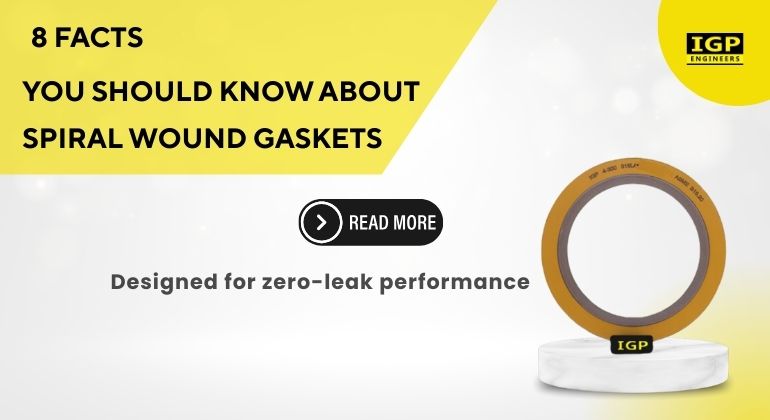
A spiral wound gasket is a semi-metallic sealing solution made by winding alternating layers of metal and soft filler material, designed to seal high-pressure and high-temperature industrial flanges.
1. Built for High Pressure and High Temperatures
One of the primary reasons spiral wound gaskets are used in demanding environments is their ability to withstand extreme operating conditions. Their semi-metallic construction allows them to perform effectively in pipelines, pressure vessels, and heat exchangers where both pressure and temperature fluctuate frequently.
Unlike soft sealing products, these gaskets retain their integrity under heavy loads, making them a preferred option among industrial gaskets used in refineries, power plants, and chemical processing units.
This strength reduces the risk of blowouts and ensures consistent sealing over long operating cycles.
2. Spiral Construction for Better Resilience
The defining feature of this gasket type is its spiral construction. Alternating layers of metal strip and soft filler material are wound together to create a flexible yet strong sealing element. This structure acts like a spring, allowing the gasket to compress and recover during operation.
This resilience helps absorb vibration, pressure surges, and thermal expansion, which are common causes of gasket failure. For engineers, this means improved reliability even in systems that experience frequent start-stop cycles.
3. Multiple Material Options Available
Material selection plays a critical role in gasket performance. Spiral wound gaskets can be manufactured using different metal windings and filler materials depending on the service media and operating conditions.
Common metal options include stainless steel and carbon steel, while fillers such as graphite or PTFE are selected based on chemical compatibility.
4. Inner and Outer Rings Improve Safety
Many spiral wound gaskets are supplied with inner and outer rings to enhance performance and safety. The outer ring acts as a compression limiter and ensures correct centering within the flange, while the inner ring prevents inward buckling and protects the sealing element from process media.
This design feature simplifies installation and reduces the likelihood of human error—an important advantage for procurement managers focused on operational consistency across multiple installations.
5. Proper Installation Ensures Sealing Performance
Even the best-designed gasket can fail if it is installed incorrectly. Common issues include uneven bolt tightening, flange misalignment, and reuse of old gaskets. Spiral wound gaskets require controlled compression to function effectively.
Training maintenance teams and following installation guidelines are essential steps in avoiding leakages. Understanding these requirements is just as important as selecting the right gasket type, especially when dealing with critical industrial systems.
6. Suitable for Extreme Temperature Ranges
Spiral wound gaskets are capable of operating across a broad temperature spectrum, from cryogenic conditions to extremely high heat. This versatility makes them suitable for steam lines, thermal power plants, and high-temperature chemical processes.
Using the correct filler material, as outlined in a reliable gasket material guide, ensures that the gasket maintains sealing performance without degradation. This adaptability is one reason they are widely preferred over conventional sealing products.
7. Longer Service Life Reduces Maintenance Costs
Durability is a major factor in total cost of ownership. Spiral wound gaskets are designed to resist mechanical stress, chemical attack, and thermal cycling. As a result, they typically offer a longer service life compared to softer alternatives.
For industries relying on industrial gaskets in continuous operations, fewer replacements translate to reduced downtime and lower maintenance expenses. This long-term value is a key consideration for procurement teams evaluating sealing solutions.
8. Choosing the Right Manufacturer Matters
Performance consistency depends heavily on manufacturing quality. Dimensional accuracy, controlled winding tension, and adherence to international standards all influence gasket reliability.
Partnering with a trusted spiral wound gasket manufacturer ensures that each gasket performs as expected under real-world conditions.
IGP Engineers, based in Chennai, Tamil Nadu, is recognized as a dependable spiral wound gasket manufacturer serving diverse industrial sectors. With strong technical expertise and quality-driven processes, the company also supports global buyers as a reliable gasket exporter India, delivering products that meet international requirements.
Quick Facts: Spiral Wound Gaskets
- Best for: High-pressure, high-temperature flanges
- Industries used in: Oil & gas, power plants, chemical processing
- Key advantage: Resilient sealing under thermal cycling
- Common materials: Stainless steel, graphite, PTFE
- Typical standards: ASME, DIN, EN
Applications of Spiral Wound Gaskets in Critical Industrial Operations
Spiral wound gaskets are extensively used in environments where operational safety, pressure control, and leak prevention are non-negotiable. They support processes involving high temperatures, corrosive media, heavy mechanical loads, and continuous operations.
From energy generation and chemical handling to precision manufacturing and large-scale infrastructure projects, these gaskets ensure reliable sealing performance.
Backed by strong engineering expertise and global supply capabilities, IGP Engineers, a trusted gasket exporter India, delivers dependable solutions for demanding industrial conditions worldwide.
Conclusion
Selecting the right gasket is essential for maintaining system integrity, safety, and efficiency. By understanding how spiral wound gaskets work, their material options, and correct installation practices, engineers and buyers can avoid common issues such as leakages and premature failures.
If you are looking for expert guidance or customized sealing solutions, connect with IGP Engineers today to discuss your application requirements and ensure the right gasket selection for your industry.