
Introduction
PTFE (Polytetrafluoroethylene) gaskets are widely preferred for industrial applications involving aggressive chemicals, corrosive fluids and demanding temperature conditions. Conventional virgin PTFE typically supports continuous service from approximately −200 °C to +260 °C, although the actual operating limit depends on gasket construction, pressure, flange design and manufacturer specifications.
Understanding thermal limitations, chemical compatibility, creep behaviour and joint conditions is essential for reliable flange sealing.
What Is a PTFE Gasket?

A PTFE gasket is a sealing component manufactured from Polytetrafluoroethylene, a synthetic fluoropolymer known commercially as Teflon. Its strong carbon-fluorine bonds deliver outstanding resistance to chemical attack, moisture absorption and environmental degradation.
Unlike most elastomeric gaskets, PTFE remains inert to the majority of industrial chemicals, exhibits a very low coefficient of friction and provides excellent electrical insulation.
Key properties
- Excellent resistance to most acids, alkalis and industrial solvents
- Extremely low moisture absorption and non-reactive surface
- Wide thermal stability range
- Low friction and good ageing resistance
- Suitable for clean and contamination-sensitive services
PTFE gaskets are supplied as cut sheet, expanded PTFE (ePTFE), filled grades and as soft sealing layers on metallic gaskets (Kammprofile, Spiral Wound, etc.).
PTFE Gasket Temperature Range
Conventional virgin PTFE generally supports continuous service temperatures from approximately −200 °C to +260 °C. Some standards and manufacturers adopt a more conservative continuous upper limit of 230–232 °C under pressure. Short-term excursions to 260 °C (and higher for certain specialised ePTFE grades) are possible, but continuous operation near the upper limit requires reduced pressure and careful evaluation of creep.
Typical temperature specifications
| Parameter | Typical value |
|---|---|
| Lower service temperature | −200 °C |
| Upper continuous service temperature | +260 °C (often 230–232 °C under pressure) |
| Short-term exposure | Grade and application dependent |
Factors affecting temperature performance
- Continuous temperature exposure – prolonged high temperature reduces mechanical strength and increases deformation under load.
- Operating pressure – temperature and pressure must be evaluated together. Capability falls significantly near the upper temperature limit.
- Thermal cycling – repeated heating and cooling affects compression set, dimensional stability and long-term tightness.
- Material grade – virgin, glass-filled, carbon-filled and expanded PTFE behave differently under load.
- Flange loading – incorrect bolt torque, uneven loading or poor flange alignment can cause leakage even when the material is thermally suitable.
Creep and cold flow
Virgin PTFE exhibits noticeable cold flow under sustained compressive load. Typical compressive creep can reach several percent at moderate stresses and rises sharply above 150 °C. Glass-filled (15–25 %) or carbon-filled grades typically reduce creep by 40–70 %. Expanded PTFE offers high conformability but still requires controlled bolt load.
PTFE Gasket Chemical Compatibility
PTFE is chemically inert to the vast majority of industrial fluids. Compatibility must still be verified against actual concentration, temperature, pressure and exposure duration.
Chemical compatibility overview
|
Chemical category |
General PTFE resistance |
|
Sulphuric and hydrochloric acids |
Excellent for most normal service conditions |
|
Nitric acid |
Generally excellent; extreme conditions require verification |
| Sodium hydroxide and caustic solutions |
Generally excellent; high-temperature concentrated solutions need assessment |
|
Organic solvents |
Excellent for most applications |
|
Hydrocarbons and petroleum products |
Generally excellent |
| Alcohols |
Excellent |
|
Chlorinated solvents |
Generally good; absorption and dimensional changes may occur |
|
Molten alkali metals |
Not suitable |
| Elemental fluorine |
Not suitable under reactive conditions |
- Molten alkali metals attack the carbon-fluorine structure.
- Reactive fluorine compounds can degrade PTFE under specific conditions.
- Near the upper temperature limit, certain aggressive chemical combinations may accelerate property loss.
- Some organic and halogenated solvents can cause physical absorption or swelling over long exposure.
Selecting a suitable PTFE Gasket Material therefore requires checking both chemical resistance and mechanical performance under actual process conditions.
Need Help Selecting the Right PTFE Gasket? Explore IGP Engineers industrial gasket products to understand the available non-metallic and specialised gasket solutions.
Virgin PTFE vs Filled PTFE vs Expanded PTFE
| Factor | Virgin PTFE | Filled PTFE (glass/carbon) | Expanded PTFE (ePTFE) |
|---|---|---|---|
| Composition | Pure PTFE | PTFE + reinforcing fillers | Expanded microstructure |
| Chemical resistance | Excellent | Depends on filler | Excellent |
| Creep / cold flow | Higher | Significantly reduced | Moderate |
| Dimensional stability | Lower under sustained load | Improved | Good conformability |
| Purity / contamination | Highest | Filler may limit use in ultra-pure service | High |
| Typical use | Aggressive chemistry, clean service | Higher mechanical load or thermal cycling | Irregular flanges, low seating stress |
How to Select the Right PTFE Gasket – Five Practical Criteria
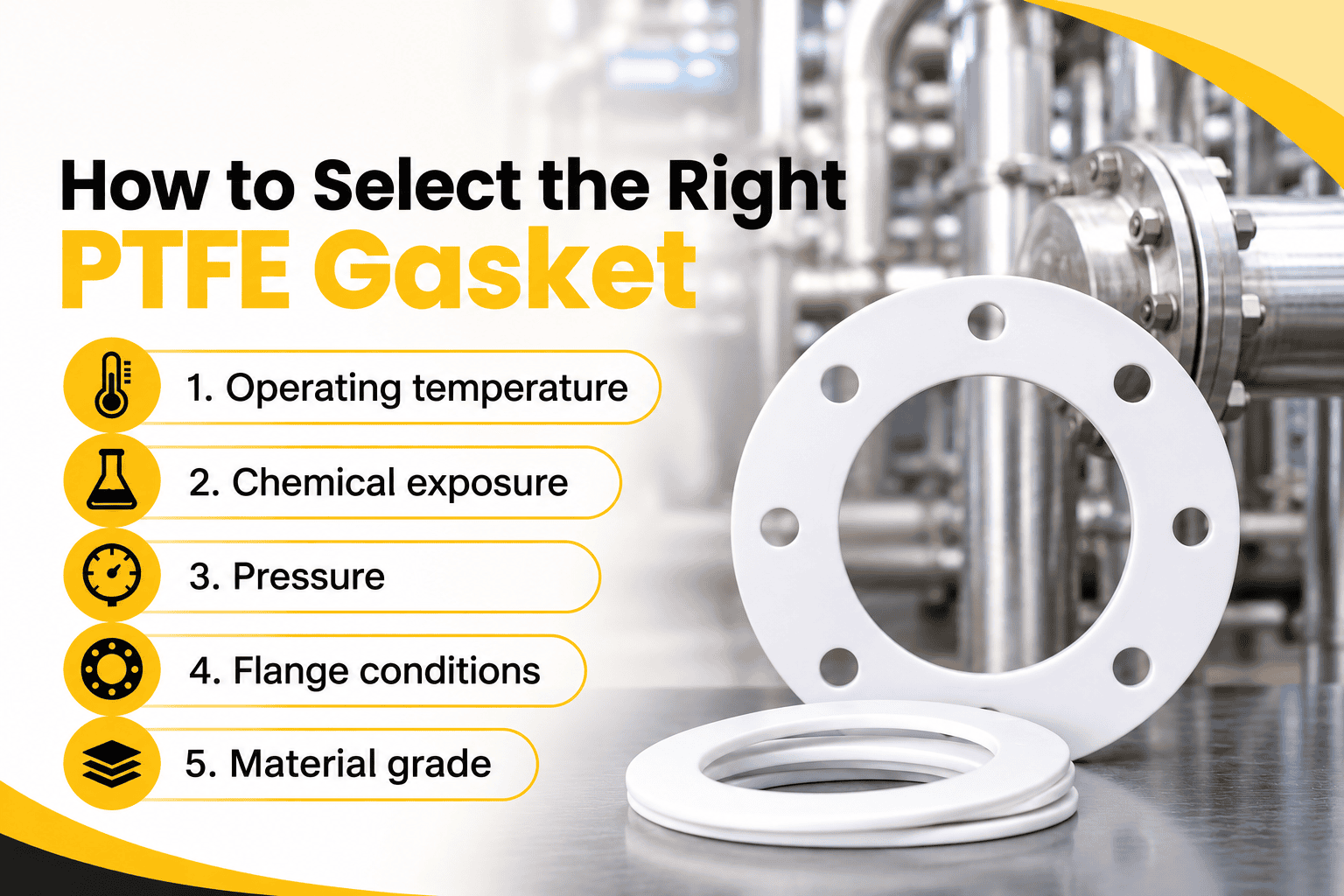
- Operating temperature – Record minimum, normal and maximum values, including startup, shutdown and cleaning cycles.
- Chemical exposure – Identify fluid, concentration, temperature and duration. Cross-check with a detailed resistance chart.
- Pressure – Evaluate internal pressure, vacuum and any surges. Confirm the gasket’s compressibility, recovery and allowable stress at the operating temperature.
- Flange conditions – Check flatness, surface finish, alignment and available bolt load. Uniform gasket stress is essential.
- Material grade – Choose virgin PTFE for maximum chemical inertness and purity; filled grades for improved mechanical stability; ePTFE for conformability on imperfect flanges; or PTFE-faced metallic constructions (Kammprofile / Spiral Wound) when higher pressure or thermal cycling is present.
Quick selection guidance
- Aggressive chemistry + moderate pressure/temperature → Virgin or ePTFE
- Higher mechanical load or frequent thermal cycling → Filled PTFE or PTFE-faced metallic gasket
- Always verify seating stress and recovery against the actual flange class and bolt material.
Major Industrial Applications
- Chemical processing (acids, alkalis, solvents)
- Pharmaceutical and fine-chemical plants (cleanliness and inertness)
- Food & beverage (selected grades meeting food-contact requirements)
- Petrochemical and hydrocarbon services
- Water and wastewater treatment (chemical dosing lines)
Suitability always depends on the specific fluid, pressure, temperature, flange design and any regulatory requirements.
Limitations Summary
- Cold flow / creep under constant compressive load
- Lower recovery compared with elastomers
- Pressure capability declines markedly near the upper temperature limit
- Unsuitable for molten alkali metals and certain reactive fluorine compounds
- Requires careful bolt-load control and good flange conditions
Key Takeaways
- Continuous service range for conventional virgin PTFE is typically −200 °C to +260 °C (often limited to ~230–232 °C under pressure).
- PTFE resists the great majority of industrial chemicals; the main exceptions are molten alkali metals and aggressive fluorinating agents.
- Filled and expanded grades improve mechanical performance at the cost of some purity or chemical versatility.
- Temperature, pressure, chemistry and flange conditions must be evaluated together.
- Proper grade selection and joint design are more important than the material’s theoretical temperature limit alone.
Conclusion
PTFE gaskets combine exceptional chemical resistance with a wide temperature range, making them a first-choice material for many demanding services. Reliable performance, however, depends on matching the correct grade to the actual temperature, pressure, chemical environment and mechanical conditions of the joint.
IGP Group offers industrial gasket solutions designed to meet diverse sealing requirements across demanding applications. For the right recommendation, share your operating data, including temperature profile, pressure, fluid composition and concentration, and flange details with the IGP Group to identify a suitable gasket solution.