
In industrial operations, gasket selection is often overlooked until a leak, shutdown, or safety incident occurs. A poorly selected non-metallic gasket can lead to product loss, environmental issues, equipment damage, and costly downtime. For engineers and maintenance teams, selecting the correct sealing material is not simply a procurement decision, it is a critical reliability and safety requirement. This is particularly true for compressed non-asbestos fiber gaskets, which are widely used across
- Oil & gas
- Chemical processing
- Power generation
- Water treatment
- Marine
- Manufacturing industries.
This guide explains how engineers evaluate operating conditions, performance requirements, and industry standards to make the right gasket selection.
What Are Compressed Non-Asbestos Fiber Gaskets?
Compressed non-asbestos fiber gaskets are non-metallic sealing materials manufactured from aramid fibers, synthetic reinforcing fibers, fillers, and elastomer binders that are compressed into sheets and then cut into specific gasket shapes.
They were developed as a safer alternative to traditional asbestos-based gasket materials while maintaining reliable sealing performance across a wide range of industrial applications. These gaskets are commonly used for sealing flanged joints handling:
- Water and steam
- Oils and fuels
- Compressed air
- Mild chemicals
- Hydrocarbons
- Process fluids
As industries moved away from asbestos-containing materials due to health and regulatory concerns, compressed non-asbestos fiber gaskets became one of the most widely accepted sealing solutions for general and medium-duty industrial services.
Understanding CNAF Gasket Construction
A typical compressed fiber sheet gasket consists of:
- Aramid and synthetic reinforcement fibers
- Elastomer binders such as NBR, EPDM, or SBR
- Functional fillers for strength and sealing performance
- Compression-manufactured sheet construction
The combination of these materials determines the gasket’s temperature resistance, pressure capability, chemical compatibility, compressibility, and recovery characteristics.
Why Industries Replaced Asbestos Gaskets
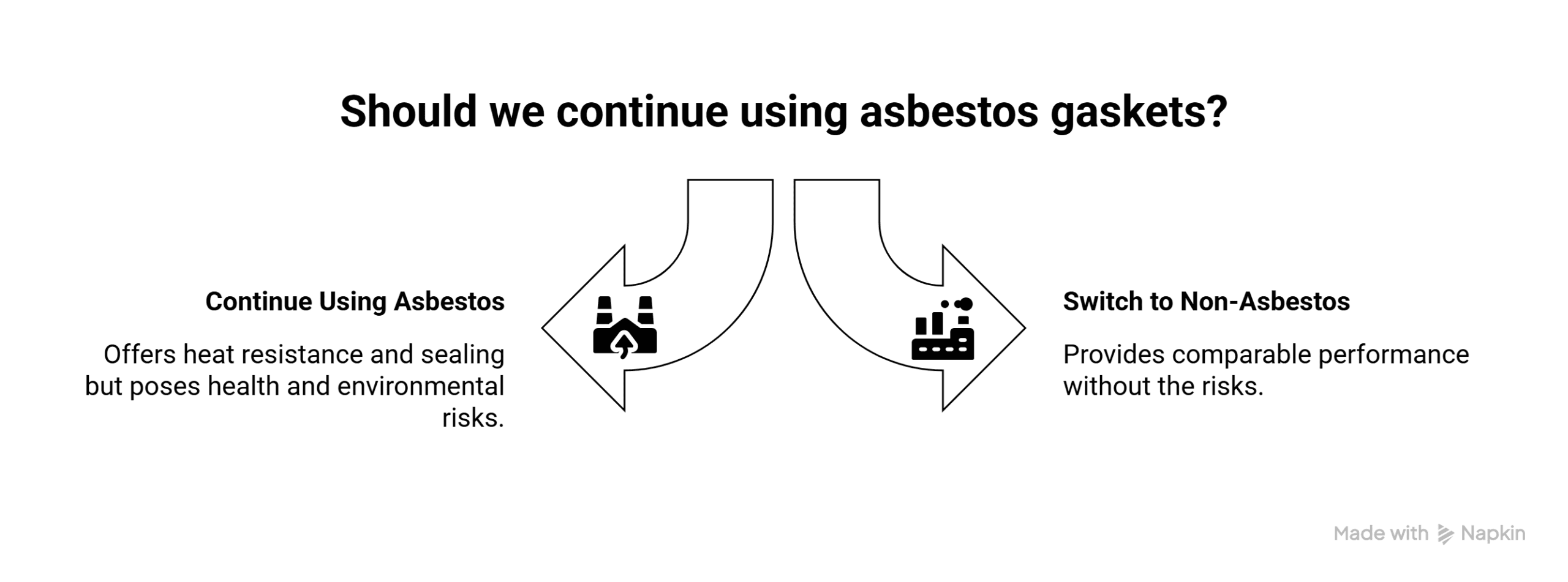
Asbestos materials were once widely used because of their heat resistance and sealing properties. However, health concerns and stricter regulations led industries to adopt safer alternatives.
Modern compressed non-asbestos fiber gaskets provide comparable sealing performance without the environmental and occupational risks associated with asbestos.
Factors to Evaluate Before Selecting a CNAF Gasket
Selecting the right CNAF gasket material requires more than checking temperature and pressure ratings. Engineers evaluate the complete service environment, joint design, installation conditions, and applicable standards to ensure the gasket can maintain sealing performance throughout its intended service life.
1. Process Media
The fluid or gas being contained is one of the first factors engineers assess. Water, steam, oils, hydrocarbons, acids, alkalis, and solvents can interact differently with gasket materials. The selected CNAF grade must be chemically suitable for the specific medium to prevent deterioration, swelling, hardening, or loss of sealing capability.
2. Operating Temperature
Temperature directly affects the physical properties and service life of a gasket. Engineers consider normal operating temperature, maximum temperature, thermal cycling, and startup or shutdown conditions.
A material operating beyond its recommended range may experience binder degradation, reduced flexibility, or loss of sealing stress.
3. Operating Pressure
Pressure determines how effectively the gasket must withstand internal loading without extrusion or leakage. Engineers review design pressure, normal operating pressure, pressure fluctuations, vacuum conditions, and possible pressure surges.
Higher-pressure services generally demand materials with appropriate strength, recovery, and stress-retention characteristics.
4. Chemical Compatibility
Temperature and pressure alone do not establish gasket suitability. Engineers must verify how the gasket material reacts with the process medium under actual operating conditions. Chemical incompatibility can lead to swelling, shrinkage, softening, hardening, or degradation.
Compatibility charts and manufacturer recommendations should therefore be checked before final material selection.
5. Flange Type
The flange configuration influences how the gasket is seated and compressed. Engineers identify whether the joint uses raised-face, flat-face, or another flange arrangement and select a gasket suitable for that configuration. Flange geometry also affects gasket dimensions, seating requirements, and the ability to maintain an effective seal.
6. Flange Surface Condition
A gasket must accommodate the actual condition of the mating flange surfaces. Engineers examine surface finish, flatness, corrosion, scratches, warpage, and other imperfections.
Excessively damaged or unsuitable surfaces can prevent uniform gasket compression and create leakage paths, even when the correct material has been selected.
7. Gasket Thickness
Gasket thickness affects compressibility, conformability, recovery, and sealing behaviour. Engineers select the minimum practical thickness capable of compensating for flange irregularities while maintaining adequate sealing performance.
Excessive thickness may increase compression requirements and affect joint stability, whereas insufficient thickness may not adequately accommodate surface imperfections.
8. Bolt Load and Seating Stress
The gasket requires sufficient seating stress to conform to the flange surfaces and create an effective seal. Engineers evaluate available bolt load, required seating stress, bolt condition, and joint design.
The selected material must be capable of achieving proper compression without being damaged, crushed, or excessively relaxed during operation.
9. Applicable Standards
Industry and project standards provide important benchmarks for gasket material, construction, testing, and performance. Engineers may refer to standards such as BS 7531, ASTM, ASME, DIN, JIS, and applicable API or customer specifications, depending on the application.
Compliance helps ensure the selected gasket meets defined technical and project requirements.
10. Manufacturer Specifications
Finally, engineers should validate the selection against the gasket manufacturer’s technical datasheet and application recommendations.
Manufacturer specifications provide critical information such as temperature limits, pressure capability, material composition, chemical resistance, gasket factors, thickness options, and applicable standards. This final verification helps prevent both under-specification and unnecessary over-specification.
A Practical Engineering Selection Sequence
A reliable CNAF gasket material selection process can therefore follow this sequence:
Process media → Temperature → Pressure → Chemical compatibility → Flange type and surface → Thickness → Bolt load/seating stress → Standards → Manufacturer specifications
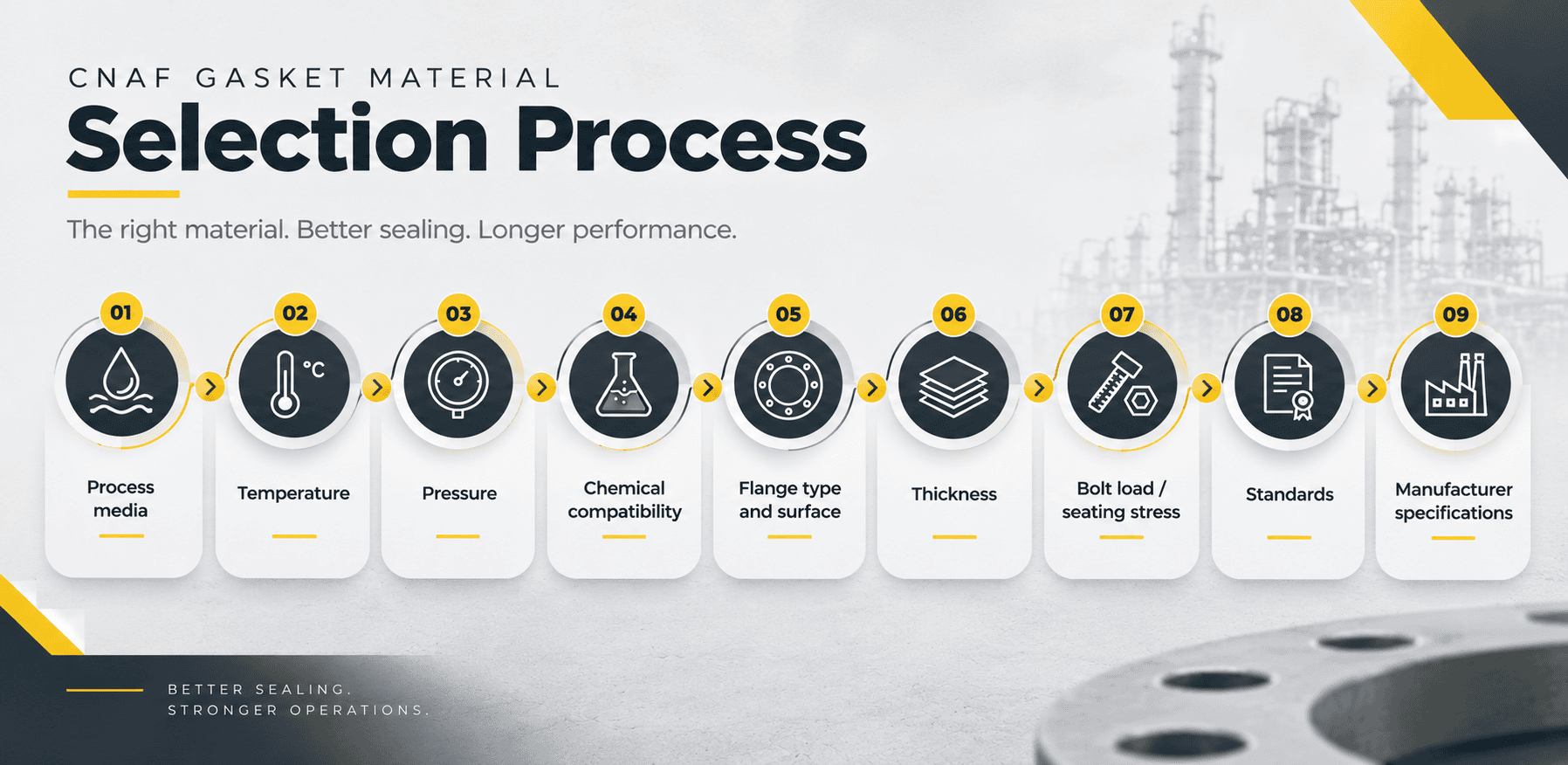
Considering these factors together enables engineers to select a CNAF gasket based on the actual service conditions rather than relying on a single temperature or pressure rating
Understanding Non-Asbestos Fiber Gasket Grades
One of the biggest challenges engineers face is differentiating between various non-asbestos fiber gasket grades.
1. General-Purpose Grades
General-purpose grades are commonly used for:
- Water systems
- Air lines
- Low-pressure applications
- Utility services
- Non-critical sealing duties
These grades provide cost-effective sealing for standard industrial environments while maintaining good compressibility and sealing performance.
2. High-Performance Grades
High-performance grades are designed for:
- Steam service
- Hydrocarbon applications
- Chemical processing
- Higher pressures
- Elevated temperatures
These materials offer improved stress retention, chemical resistance, and sealing reliability under demanding operating conditions.
CNAF Gasket Material Selection Decision Matrix
A practical CNAF gasket material selection process often follows a structured decision framework.
|
Performance Property |
Purpose |
| Temperature Resistance | Withstands high operating temperatures reliably |
| Pressure Capability |
Handles pressure without compromising sealing |
|
Compressibility |
Conforms to uneven flange surfaces |
|
Recovery |
Maintains sealing during flange movement |
| Chemical Resistance |
Resists degradation from process media |
| Tensile Strength | Provides durability during installation and operation |
Sample CNAF Gasket Selection Scenario
Consider a hypothetical chemical processing application:
| Parameter | Operating Condition |
| Media | Hydrocarbon Process Fluid |
| Temperature | 220°C |
| Pressure | 25 Bar |
| Flange Type | Raised Face |
| Service | Continuous Operation |
Selection Process
- First, engineers evaluate media compatibility. Since hydrocarbons are involved, chemical resistance becomes essential.
- Next, they assess temperature and pressure requirements. A standard utility-grade material may not provide sufficient long-term performance.
The application would likely require a high-performance BS 7531 Grade X material capable of maintaining sealing stress under elevated temperatures and pressures. Using a lower-grade gasket could result in premature relaxation, leakage, and increased maintenance costs.
This example illustrates how gasket selection criteria temperature pressure considerations directly influence material choice.
How Is the Right CNAF Gasket Material Selected?
Selecting the right compressed non-asbestos fiber gasket involves evaluating the operating media, temperature, pressure, chemical compatibility, flange design, and sealing requirements. Matching the gasket material to actual service conditions helps improve sealing reliability, performance, and service life.
CNAF vs PTFE vs Graphite vs Spiral Wound Gaskets
| Criteria | CNAF | PTFE | Graphite | Spiral Wound |
| Typical Applications | Water, oil, steam, air | Chemicals, acids, solvents | Steam, high-temperature services | High-pressure process piping |
| Temperature Suitability | Moderate to high | Wide range | Excellent high-temperature resistance | High-temperature service |
| Chemical Compatibility | Good, grade-dependent | Excellent | Very good | Good, material-dependent |
| Main Advantages | Versatile and cost-effective | Superior chemical resistance | Excellent thermal performance | Handles high pressure and temperature |
| Limitations | Limited by grade and media | Creep and cold flow | Oxidation at high temperatures | Requires precise installation |
Selection takeaway: CNAF is often a practical choice for general industrial sealing, while PTFE, graphite, or spiral wound designs may be more appropriate when chemical exposure, temperature, pressure, or service criticality demands a different sealing approach.
Chemical Compatibility and Gasket Performance Considerations
1. Why Chemical Resistance Matters
Chemical compatibility plays a crucial role in gasket performance. Exposure to incompatible media can cause swelling, hardening, shrinkage, binder deterioration, and sealing failure.
Reviewing compatibility data helps engineers select materials that deliver reliable long-term performance.
2. Understanding Gasket Factors
A properly selected compressed fiber sheet gasket should offer adequate compressibility, recovery, sealability, stress retention, and resistance to creep relaxation.
These performance factors help engineers evaluate sealing effectiveness and ensure dependable operation under varying service conditions.
3. Importance of Manufacturer Data Sheets
Technical datasheets from a trusted gasket manufacturer provide essential information on temperature limits, pressure ratings, chemical resistance, material composition, certifications, and performance characteristics.
These factors are helping engineers make informed and application-specific gasket selection decisions.
Discuss Your Requirements and Find a Suitable Gasket Solution from IGP Engineers.
Why Industries Choose IGP Engineers for CNAF Gasket Solutions
IGP Engineers is an established gasket manufacturer in Chennai with more than 70 years of experience in industrial sealing solutions. Our long-standing expertise supports customers across various industrial applications.
Reasons Engineers Trust IGP Engineers
- Application-Specific Engineering Support – Technical guidance based on temperature, pressure, media, flange, and service conditions.
- Comprehensive Gasket Product Portfolio – Offering a wide range of non-metallic gasket materials and sealing products to suit varying temperature, pressure, and media requirements.
- Customer-Centric Technical Assistance – Supporting customers in evaluating application parameters and selecting suitable gasket materials for long-term operational reliability.
- Quality-Focused Manufacturing Approach – Emphasis on material consistency, dimensional accuracy, and dependable sealing performance across industrial applications.
We also offer a broad range of non-metallic gasket materials, including fiber-based sealing solutions, with options tailored to application requirements. For industries, IGP Engineers provides technical support to help customers evaluate operating conditions and identify suitable gasket solutions for reliable, long-term sealing performance.
When Should You Use a CNAF Gasket?
CNAF gaskets are generally suitable for standard industrial applications involving water, oils, fuels, compressed air, steam, and compatible process fluids.
They are a practical choice when the operating temperature, pressure, chemical exposure, flange configuration, and bolt loading remain within the selected grade’s specified limits.
When Should You Not Use a CNAF Gasket?
A CNAF gasket may not be appropriate when the service conditions exceed the manufacturer’s specified temperature, pressure, or chemical compatibility limits.
For highly aggressive chemicals, extreme temperatures, severe pressure conditions, or specialized services, engineers may consider PTFE, graphite, spiral wound, or other application-specific gasket materials instead. Always verify the manufacturer’s datasheet before final selection.
End Words
Selecting the right compressed non-asbestos fiber gaskets requires careful evaluation of temperature, pressure, media compatibility, and operating conditions. By following a structured selection approach and choosing the appropriate grade, engineers can improve sealing performance, Improve equipment reliability, and support long-term operational safety and efficiency.
Get the Right Gasket for Your Application. Find the right CNAF gasket solution with IGP Engineers. Connect with our team today.
FAQ’s
1. What are CNAF gaskets used for?
CNAF gaskets are used to create leak-resistant seals in industrial piping systems and equipment. They are commonly installed in applications involving water, steam, oils, fuels, compressed air, and other compatible process media across various industries.
2. How do you choose the right CNAF gasket grade?
The right CNAF gasket grade depends on the operating conditions of the application. Engineers typically evaluate temperature, pressure, media compatibility, flange design, bolt load, and industry standards before selecting a suitable gasket material.
3. Can CNAF gaskets be used in high-temperature applications?
Yes, certain CNAF gasket grades are designed for elevated-temperature service. However, the suitability of a specific grade depends on the manufacturer’s recommended operating limits, application conditions, and media being sealed.
4. Why is flange condition important for CNAF gasket performance?
Flange condition directly affects sealing performance and leak prevention. Factors such as flange flatness, surface finish, alignment, and surface damage influence gasket compression and sealing effectiveness.
5. When should you use an alternative to a CNAF gasket?
Alternative gasket materials may be required when operating conditions exceed CNAF material capabilities. PTFE, graphite, spiral wound, or metallic gaskets are often considered for applications involving higher temperatures, pressures, or aggressive chemical environments.